
Why you should not stack fan spacers
Where is my fan supposed to be?
- About half the depth of the blade should be inside the fan shroud.
- The forward edge of the fan blades should be at least 3/4-1" from the radiator core..
- The tips of the blades should clear the edge of the shroud by at least 3/4".
- The backside of the fan blades should clear any other obstruction by at least ½ in.
- Belts
- Hoses
- any other engine parts

I need a spacer...what size spacer do I need?
Every engine/vehicle combination will be slightly different. Spacers are available from 3/8" to 5" thick. However, stacking spacers together can create side load and spacing the fan out more than 2" is NOT recommended by us.
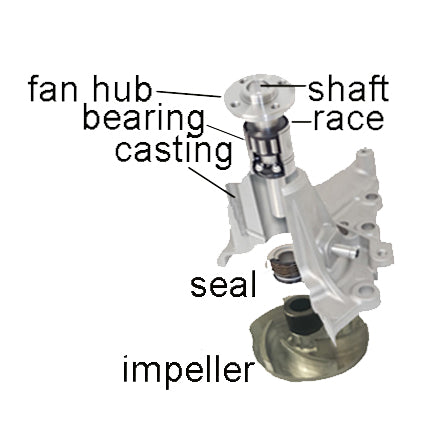
- As the fan gets further away from the pump it will increase leverage and side-load and create a mechanical lever.
- The larger the fan the greater the risk. The further the fan the greater the risk of t his leverage.
- The rotational weight and the resistance of the fan pulling air exerts a continuous bending and side-load force on the water pump shaft and bearing.
- Side loading translates to severe, uneven friction and in bearings, it causes flaking and rapid metal fatigue.
The longer the spacer, the more any slight imbalance in the fan blades is magnified. - If/when the fan wobbles, the continuous wobble acts like a rapid hammer against your water pump bearings.
- Long spacers require longer bolts, which are more susceptible to flex, stretching, or shearing.
- Use of washer and not a flat surfaces & balance spacer can cause the fan to lose concentricity.
All of this (1) shortens the bearing life and (2) makes the fan unstable. If the pump does not fail, the fans can shear the pump shaft or pull the hub off. The result can be catastrophic; a fan flying into the radiator, belts, hood or people.
We cannot control the installation and the changes that may occur with multiple moving mechanical parts and as such we do not warranty these disasters.
If you think you need to move your fan more than 2" forward. Consider minimizing the need by (1) fabricate a deeper fan shroud (2) relocate the radiator toward the engine with shims and air deflection panels (3) using a tall pump rather than a short pump.
Continue reading